Modern applications often rely on databases that prioritize the present state of data. When a record is updated, the previous value is overwritten. When it is deleted, it disappears entirely. This approach is efficient and widely accepted because it aligns with how we typically think about systems: we care about what is, not necessarily what was.
However, not all systems can afford to forget. In many scenarios, understanding how a system reached its current state is just as important as the state itself. This is where Event Sourcing emerges as a powerful architectural pattern.
What Is Event Sourcing?
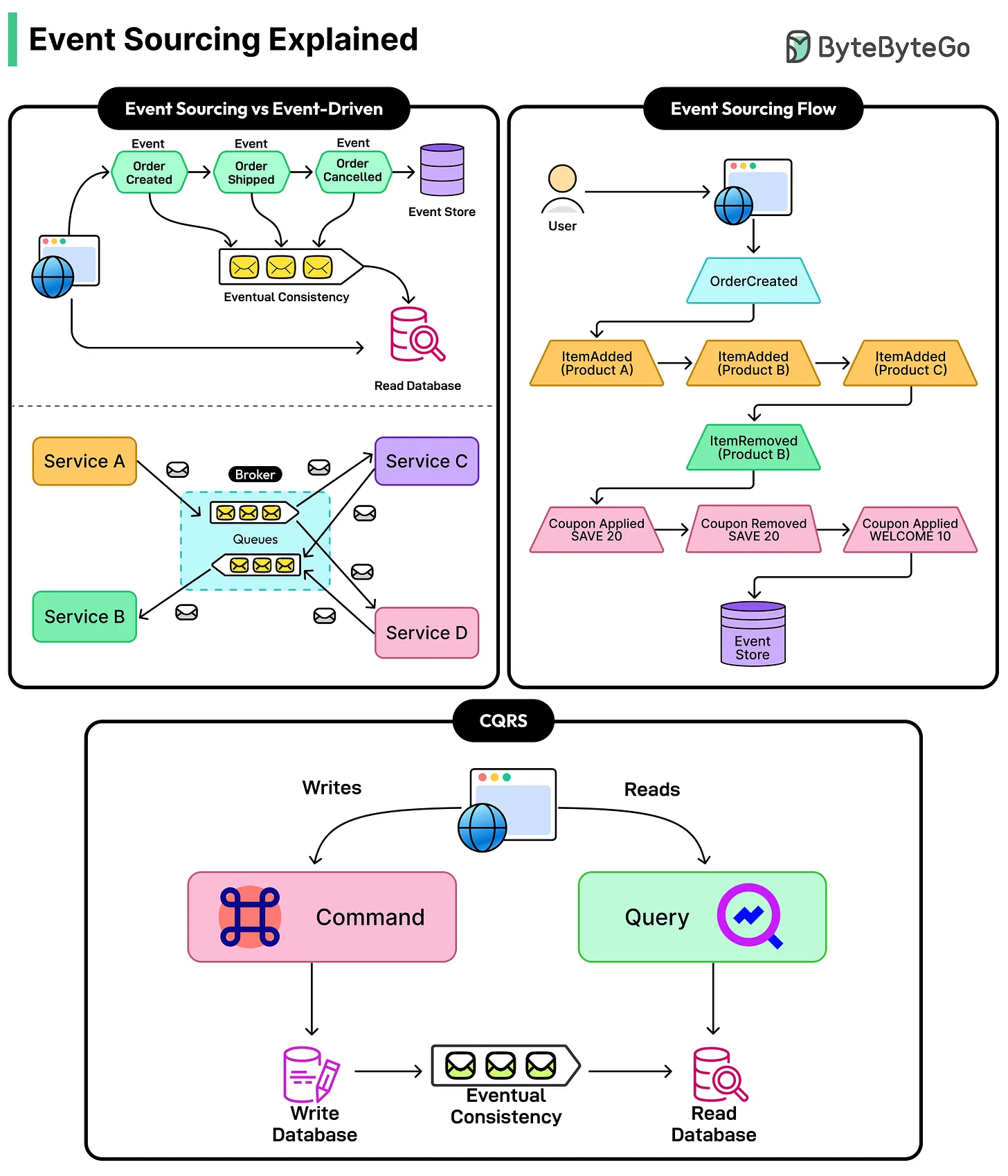
Event Sourcing is a design approach in which all changes to an application’s state are stored as a sequence of immutable events. Instead of persisting only the latest state of an entity, the system records every action or change that has occurred over time.
For example, rather than updating a user’s account balance directly in a database, an event-sourced system would record events such as:
“Account Created”
“Money Deposited”
“Money Withdrawn”
The current state is then derived by replaying these events in order. In other words, the system’s present state becomes a result of its entire history.
Why Traditional Models Fall Short
Traditional CRUD-based systems (Create, Read, Update, Delete) focus on storing the latest version of data. While this works well for many applications, it introduces certain limitations:
Loss of historical data: Once an update occurs, the previous value is gone unless explicitly archived.
Limited traceability: It becomes difficult to reconstruct the sequence of changes that led to a particular state.
Audit challenges: Regulatory or compliance requirements often demand a detailed history of changes.
Event Sourcing addresses these limitations by treating every change as a first-class citizen.
Key Benefits of Event Sourcing
1. Complete Audit Trail
One of the most compelling advantages of Event Sourcing is the ability to maintain a full history of changes. Every action is recorded as an event, creating a transparent and traceable log.
This is particularly useful in domains such as finance, healthcare, and e-commerce, where auditing and accountability are critical.
2. Debugging and Observability
When issues arise in a traditional system, developers often struggle to understand what went wrong due to the lack of historical context. With Event Sourcing, you can replay events to reconstruct the system’s state at any point in time.
This makes it significantly easier to debug issues, analyze anomalies, and understand system behavior.
3. Time Travel and State Reconstruction
Event Sourcing enables “time travel” capabilities. You can rebuild the state of the system as it existed at any moment in the past by replaying events up to that point.
This is especially useful for:
Historical reporting
Root cause analysis
Simulations and testing
4. Flexibility in Data Models
Since the source of truth is the event log, you can create multiple projections or views of the same data. These projections can be tailored for different use cases without altering the underlying data.
For instance, the same set of events can power:
A real-time dashboard
Analytical reports
Machine learning models
5. Better Integration with Distributed Systems
Event Sourcing aligns naturally with modern distributed architectures. Events can be published and consumed by multiple services, enabling loose coupling and better scalability.
This makes it a strong fit for microservices-based systems where different services react to changes independently.
Common Use Cases
Event Sourcing is not a one-size-fits-all solution, but it excels in specific scenarios:
Financial Systems
Banking and payment platforms benefit greatly from maintaining a complete transaction history. Event Sourcing ensures accuracy, traceability, and compliance.
E-commerce Platforms
Tracking order lifecycle events—such as creation, payment, shipment, and delivery—provides better visibility and enables more sophisticated business logic.
Collaborative Applications
Applications like document editors or shared workspaces can use events to track every change, making it easier to implement undo/redo functionality and collaboration features.
IoT and Monitoring Systems
Devices generating continuous streams of data can store events for analysis, anomaly detection, and predictive maintenance.
Challenges and Trade-Offs
While Event Sourcing offers many advantages, it also introduces complexity that must be carefully managed.
1. Increased Complexity
Implementing Event Sourcing requires a shift in mindset. Developers must think in terms of events rather than state transitions, which can be challenging initially.
2. Storage Requirements
Since every event is stored indefinitely, the volume of data can grow significantly over time. Efficient storage and archiving strategies become essential.
3. Event Schema Evolution
As systems evolve, event structures may need to change. Managing backward compatibility and ensuring older events can still be processed correctly is a non-trivial task.
4. Performance Considerations
Rebuilding state by replaying events can be time-consuming if the event stream is large. To mitigate this, systems often use snapshots—periodic captures of the current state—to reduce replay time.
5. Eventual Consistency
Event Sourcing systems often rely on asynchronous processing, which can lead to eventual consistency rather than immediate consistency. This may not be suitable for all use cases.
Best Practices for Implementation
To successfully adopt Event Sourcing, consider the following practices:
Define clear event boundaries: Ensure events represent meaningful business actions.
Use immutable events: Once created, events should never be modified.
Implement versioning: Handle changes in event structure gracefully.
Leverage snapshots: Improve performance by storing periodic state checkpoints.
Design for idempotency: Ensure events can be safely replayed without unintended side effects.
When Should You Use Event Sourcing?
Event Sourcing is most beneficial when:
You need a complete history of changes
Auditability and traceability are critical
The system involves complex business workflows
You are building event-driven or distributed architectures
However, for simple applications with straightforward data requirements, the added complexity may outweigh the benefits.
Conclusion
Event Sourcing challenges the conventional approach of storing only the current state by emphasizing the importance of history. By capturing every change as an event, it provides unparalleled visibility, flexibility, and control over system behavior.
That said, it is not a silver bullet. It demands careful design, thoughtful implementation, and a willingness to embrace complexity. When applied in the right context, however, Event Sourcing can transform how systems are built, understood, and evolved over time.
Ultimately, the decision to adopt Event Sourcing should be guided by the specific needs of your application—especially whether understanding the journey is just as important as knowing the destination.